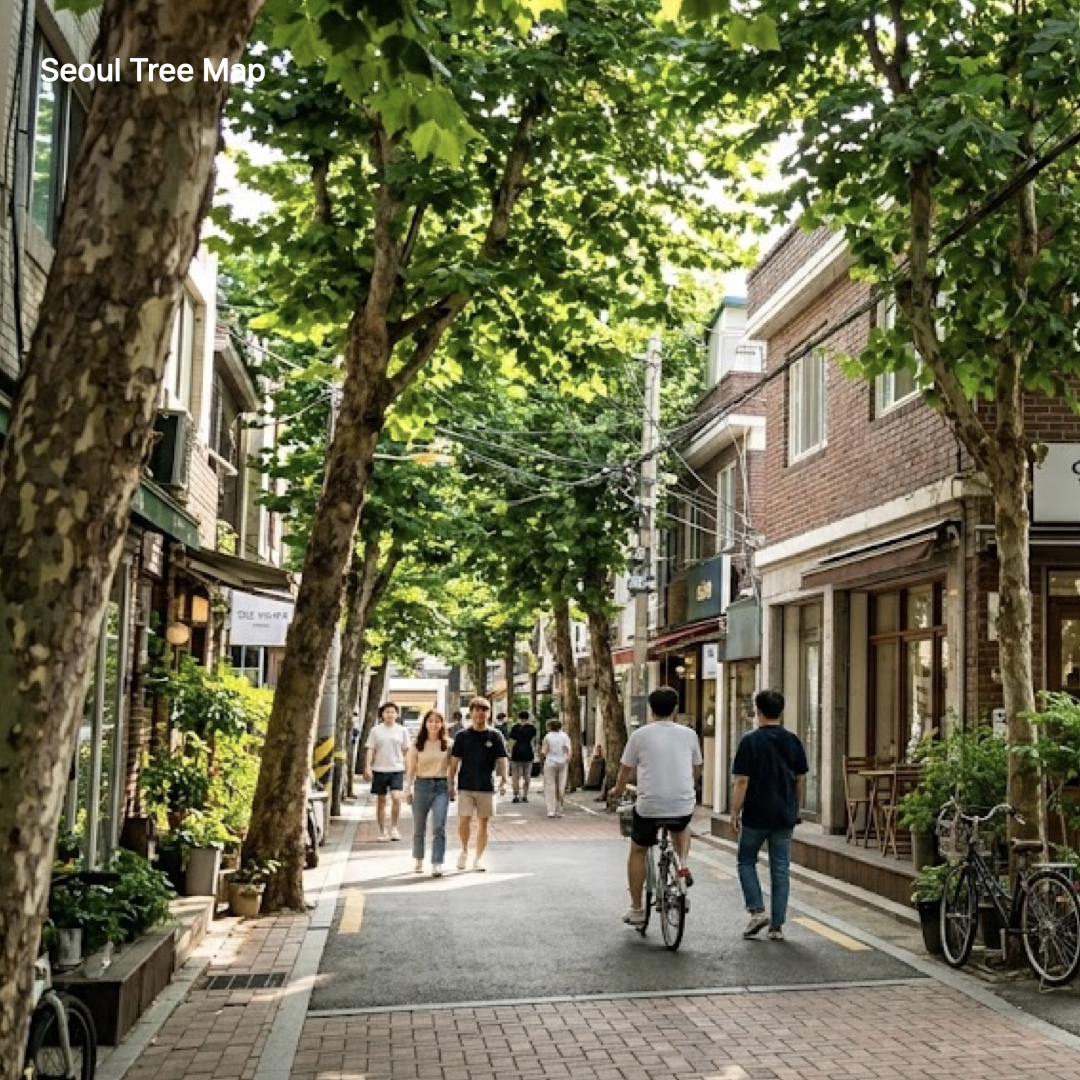
 Seoul Tree Map
Can Trees Boost Sales?
A Comprehensive Analysis of Seoul's 430,000 Trees and 1,650 Commercial Districts' Sales
Seoul's open data records roughly 430,000 trees across the city — 250,000 street trees and 170,000 trees in parks, apartment complexes, and schools. Could these trees we pass by mindlessly every day actually be affecting nearby shop sales?
They really are.
To answer this question, we combined 7 types of data released by Seoul Metropolitan Government. The location and size of each of the 430,000 trees, quarterly sales data from 1,650 commercial districts, 300,000 store records, and foot traffic data. We counted how many trees were within a 500-meter radius of each commercial district center and statistically analyzed whether this number was related to sales.
Cafes and Bars Benefit from Trees. Restaurants Don't.
When you hear "more trees mean higher sales," what kind of store comes to mind?
The data's answer was more specific than expected. When we compared sales between the top 25% and bottom 25% of green space levels around 1,041 neighborhood commercial districts in Seoul, clear differences emerged by business type.
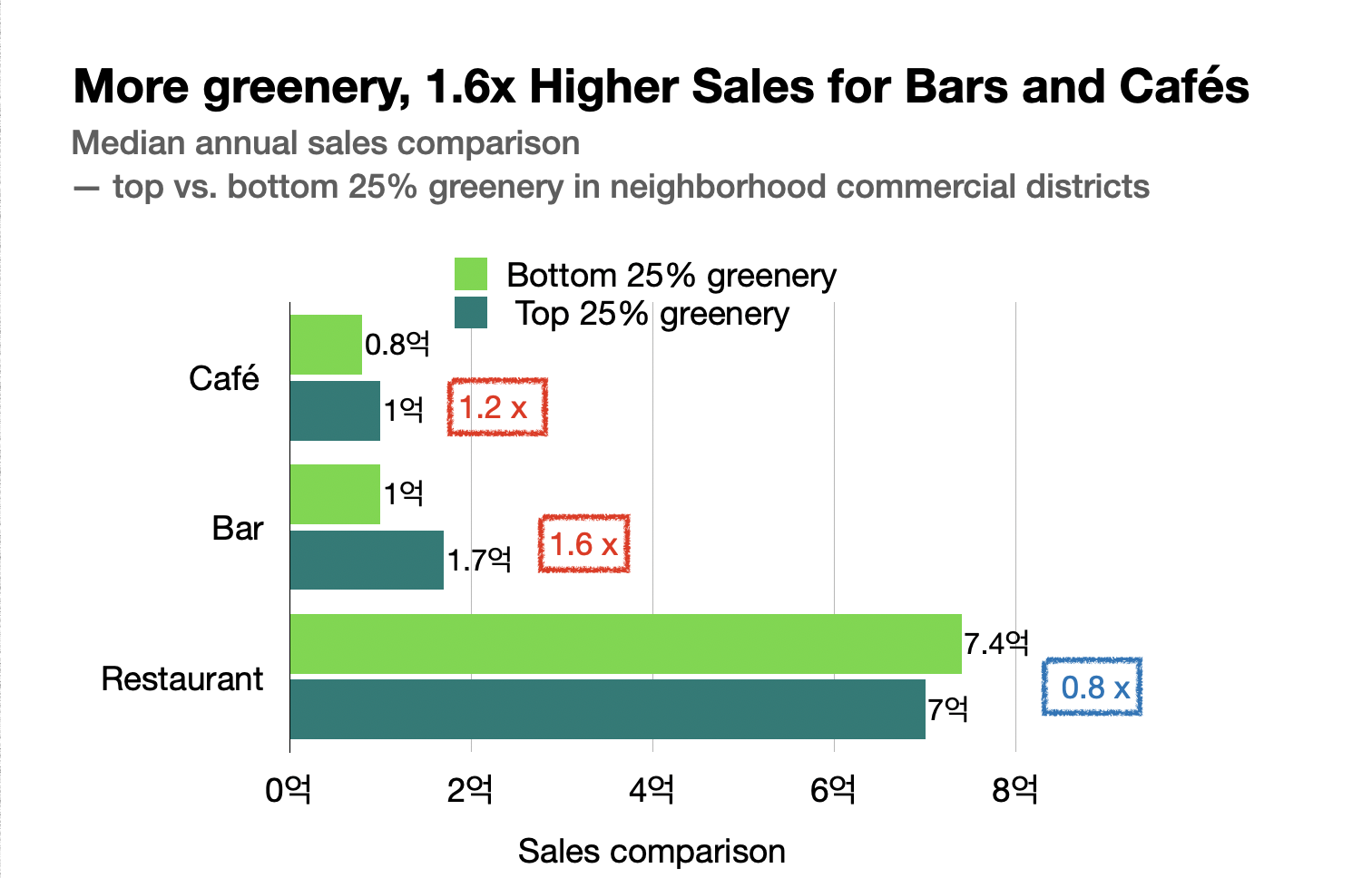
| Business Type | Top 25% vs Bottom 25% Green Level |
|---|---|
| Bars | 1.6x |
| Cafes | 1.2x |
Why does this pattern only appear in cafes and bars?
Think about when you go to a restaurant. "What should I eat today?" Taste, price, and distance are almost everything. You don't really care whether there are trees in front of the store or not. But cafes are different. When choosing "where to spend time," we unconsciously consider the street's atmosphere. A cafe on a quiet alley lined with trees versus a cafe on a gray roadside between concrete buildings. Even for the same americano, our choice might differ.
This is exactly the difference the data shows. The effect of trees appears in industries where "where to consume" rather than "what to consume" is important.
Higher Sales Where Big Trees Grow — But There's a Catch
There was an even more interesting discovery. Tree size showed a stronger relationship with sales than the number of trees.
Seoul's street tree data includes information called 'crown width' for each tree. This records in meters how far the branches extend left and right. When we analyzed based on this crown width, we found significant relationships across all business types, including restaurants that showed no relationship with simple tree count.
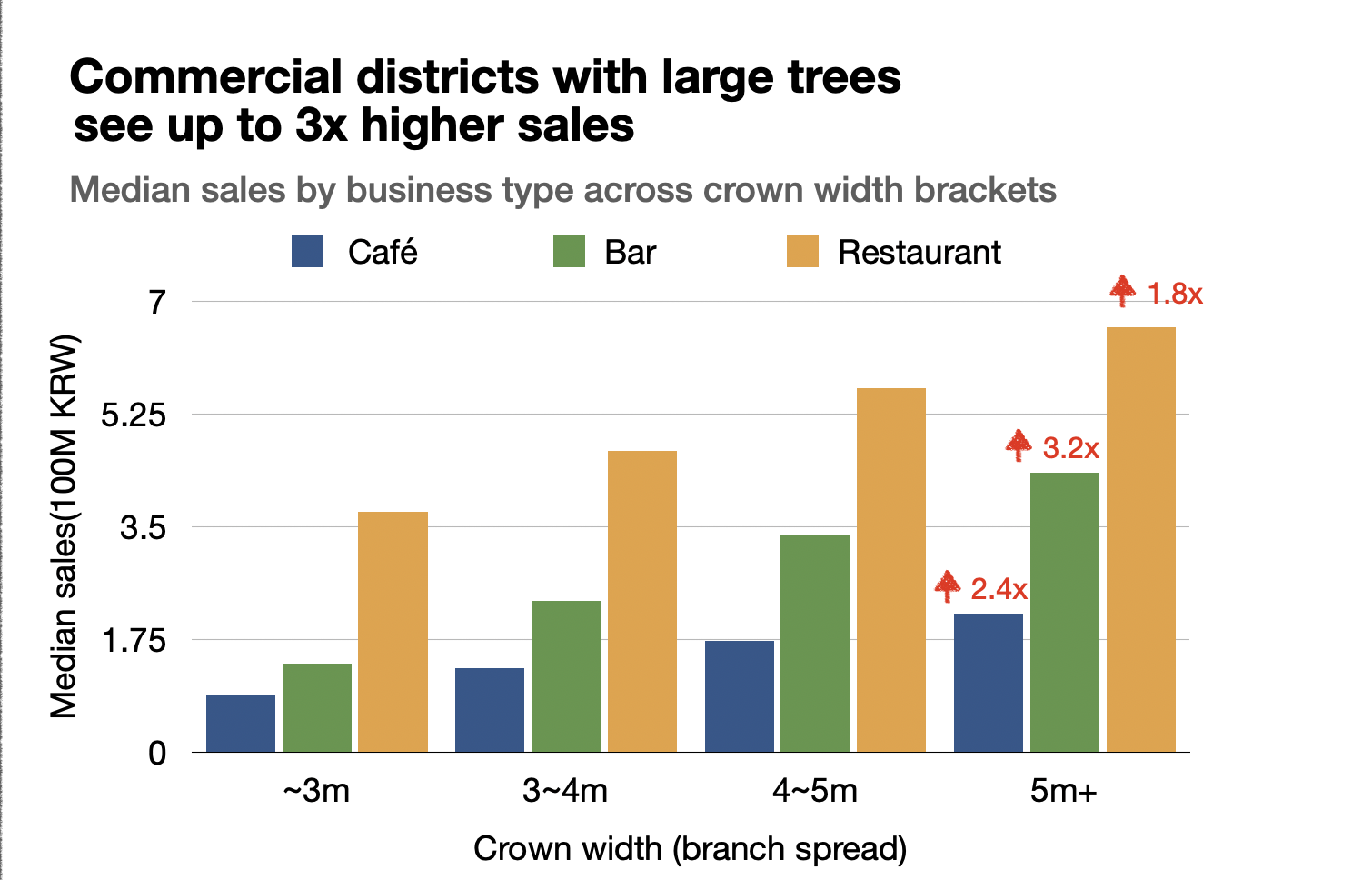
| Business Type | Sales Ratio: Crown Width 5m+ vs 3m- |
|---|---|
| Bars | 3.2x |
| Cafes | 2.4x |
| Restaurants | 1.8x |
But there's important context here. Street trees with large crown widths aren't planted just anywhere. In Seoul, most large trees with branches extending over 5 meters are planted along wide main roads, major intersections, and old arterial roads. These roadside areas already have high foot traffic, expensive land prices, and developed commercial districts.
Looking at the actual data, commercial districts with larger crown widths also had more cafe stores. In other words, it's difficult to completely distinguish with this data alone whether "big trees increased sales" or "big trees were originally in places where business does well."
To separate this, we extracted only neighborhood commercial districts and compared sales per store while controlling for the number of stores.
| Indicator | High Crown Width | Low Crown Width | Note |
|---|---|---|---|
| Number of Cafe Stores | 5.0 | 4.8 | Nearly the same |
| Sales per Cafe Store | 17.97 million won | 15.57 million won | 1.15x |
The fact that individual sales are higher despite the same number of stores suggests the possibility of environmental effects from the trees themselves that cannot be explained by location effects alone. However, since we haven't yet controlled for variables like land prices, income levels, and subway accessibility, it's premature to conclude that "big trees increase sales." We plan to verify this more precisely in follow-up research by linking real estate price data.
Cherry Blossoms Really Do Make Money. Fall Foliage Doesn't.
Looking at seasonal patterns revealed interesting findings. The economic effect of cherry blossoms was clearly captured in the data, but autumn foliage had no relationship with sales.
Seoul has about 19,000 cherry trees. We compared spring season (April-June) cafe sales changes between commercial districts with 50 or more cherry trees within a 500-meter radius and those with no cherry trees at all.
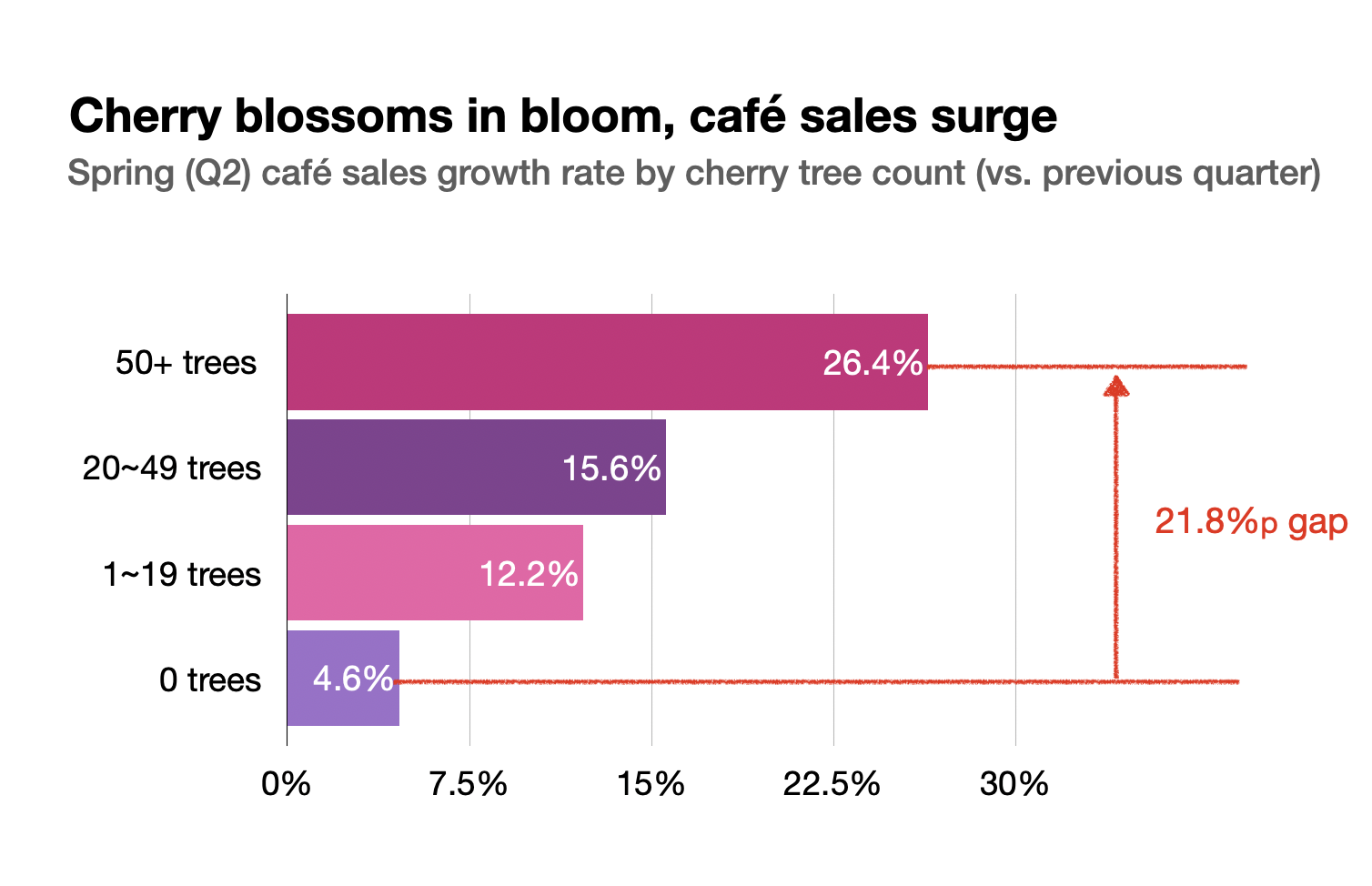
| Category | Spring (Q2) Cafe Sales Growth Rate |
|---|---|
| Districts with 50+ Cherry Trees | +26.4% |
| Districts with No Cherry Trees | +4.6% |
| Difference | 21.8%p |
These figures represent 3-month averages where the 2-week cherry blossom period is diluted. The actual effect during the 2 weeks when cherry blossoms bloom is estimated to be much greater.
In contrast, ginkgo trees (141,000 trees), the most numerous in Seoul, and maple trees (7,000 trees) had no effect on autumn sales.
Why do only cherry blossoms have an effect? We see three reasons.
First, behavioral patterns connected to consumption. Cherry blossom viewing naturally leads to "having a cup of coffee while strolling." Meanwhile, autumn foliage viewing often occurs inside mountains or parks, making it difficult to directly connect to nearby store sales.
Second, timing concentration. Cherry blossoms bloom explosively for about 2 weeks. People flock during those 2 weeks. Fall foliage, however, gradually changes color over more than a month, so people don't concentrate during a specific period.
Third, the ubiquity of ginkgo trees. With 141,000 trees spread evenly throughout Seoul, having many ginkgo trees doesn't make a neighborhood particularly special. "Something that's everywhere" doesn't become a differentiating factor.
"Would More Shade in Summer Increase Sales?" — Contrary to Expectations
Intuitively, commercial districts with lots of tree shade should see higher sales in midsummer since they're more comfortable to walk in. But the data didn't support this expectation.
The relationship between trees and sales was nearly identical across spring, summer, fall, and winter. It didn't get particularly stronger in summer. The same was true when analyzing by crown width (shade size).
However, there was one interesting clue. Looking at "actual purchase rate among passersby" (conversion rate) rather than absolute sales, we found a phenomenon where conversion rates increased more in summer in busy areas lacking shade. This can be interpreted as "going into any store because it's too hot" behavior appearing in commercial dense areas without shade. Conversely, places with large trees had stable conversion rates whether summer or winter.
This is interesting because it suggests the effect of trees is closer to psychological factors like place atmosphere rather than physical comfort like shade. The relationship between trees and sales isn't just a summer story. It's a constant effect that works year-round.
"Isn't That Just an Already Prosperous Neighborhood?"
Reading this far, you naturally have doubts. "Isn't it that places with many trees are originally wealthy neighborhoods, so sales are also high?"
That's a valid point. So we verified this doubt from multiple angles.
Do places with more trees also have more stores? No. There was no relationship between surrounding green levels and the number of stores. Having more trees doesn't mean stores are more densely clustered.
Then, even with the same number of stores, are individual sales higher? Yes. Comparing the top 25% and bottom 25% of green levels in neighborhood commercial districts, the number of cafe stores was nearly the same at 5.0 vs 4.9, but sales per store differed by 1.39 times at 19.86 million won vs 14.32 million won.
Does the relationship remain even after removing store number differences? Yes. Even after statistically removing the store number variable, significant relationships were maintained for both cafes and bars.
Of course, we cannot conclude from this alone that "trees increase sales." We haven't yet controlled for variables like land prices, resident income levels, and subway accessibility. However, we could at least statistically reject the strongest counterargument that "it's because that neighborhood originally had developed commercial districts."
Small Trees Throughout the Neighborhood Beat One Big Park
There was another interesting discovery. Being next to a big park didn't mean higher sales.
We separately obtained the locations of Seoul's 131 major parks and compared sales between "commercial districts with parks within 500 meters" and "those without." The result? No difference across all business types. Sales were similar whether there were parks or not.
What was related to sales wasn't parks but the overall green density of the neighborhood. Apartment complex landscaping, school campus trees, large and small trees along streets — the "overall green atmosphere of the neighborhood" created by these elements was important. Neighborhoods with trees scattered throughout alleys showed stronger relationships with sales than having one large park.
So What Could Change?
Urban Policy Perspective
What this data tells us is quite simple. Quality over quantity.
Growing existing trees large could create more value for commercial districts than planting 100 new seedlings. The sales difference between commercial districts with trees over 5 meters crown width and those under 3 meters was up to 3 times.
Cherry tree placement is also worth reconsidering. The fact that commercial districts with 50+ cherry trees saw 21.8%p higher cafe sales in spring means planting cherry trees in cafe-dense areas could be commercial district revitalization investment, not just aesthetic projects.
And distribution matters more than location. Small trees throughout alleys creating "overall green neighborhood atmosphere" was more strongly connected to sales than one big park.
Business Startup Perspective
When choosing locations for cafes or bars, it's worth noting how many trees are in the surrounding area. In neighborhood commercial districts, green-rich locations had up to 1.4 times higher sales per store. Of course, trees alone don't guarantee sales, but if other conditions are similar, tree-lined alleys might be better choices.
Conclusion
Don't the trees around you look a little different now when you walk down alleys?
When you wonder "why do cafes here do so well?" in some alley, turn around and look. There might be a big tree standing there.
Analysis Methodology
- Data Sources: 7 types from Seoul Open Data Plaza API (Street Tree Location OA-1325, Non-Street Trees OA-15551, Parks OA-394, Commercial District Areas OA-15560, Store Status, Estimated Sales, Foot Traffic)
- Analysis Period: Q1-Q4 2024
- Spatial Analysis: Generated 500m radius circular buffers from each commercial district center point, aggregated tree count and average crown width within buffers. Distance calculations based on UTM52N coordinate system (EPSG:32652)
- Statistical Methods: Spearman rank correlation (robust to non-linear relationships), partial correlation analysis (controlling confounding variables), Mann-Whitney U test (two-group comparison), Kruskal-Wallis H test (multi-group comparison)
- Analysis Scope: 25 Seoul districts, 1,650 commercial districts, 434,564 trees (256,186 street trees + 178,378 non-street trees)
- Tools: Python 3.11 (pandas, geopandas, scipy, statsmodels, pingouin, matplotlib, seaborn)
This analysis was conducted using open data from [Seoul Open Data Plaza](https://data.seoul.go.kr).